
THE ALWAYS PRESENT DANGER OF ONE-DIRECTIONAL LEADERSHIP
By the grace of God I realized that I was about to make a leadership mistake as I was planning to teach a Sunday School class called “Holy Sexuality.”
My plan was to talk about things such as transgenderism and same-sex attraction. Those are important topics and we as church leaders do need to teach what the Bible has to say about them. The mistake I was about to make is that all of my topics were largely directed to those who are not a committed part of our church family. I’m not saying that we don’t have people who are working through these issues personally (or within their family) but for the most part we could all nod our head and agree that these issues were about someone else, and not us. Then a profound question struck me, why am I not talking about divorce in this class? Divorce is certainly a huge problem in our culture, but it also has impacted many people in the church. The truth of the matter is that teaching what the Bible has to say about divorce is much more challenging than it is to discuss transgenderism. It involves the hard work of looking inward and not merely “out there” at the world.
Thanks to the Holy Spirit prompting me I added the topic of divorce even though it was hard for some of our people to hear and to process.
WHAT IS MULTI-DIRECTIONAL LEADERSHIP?
Trevin Wax explains it this way:
This book exhorts pastors and church leaders toward a vision of leadership I call “multi-directional,” which I contrast with the more common (and less effective) “one-directional” leadership. One-directional leaders are skillful in spotting and thwarting threats to the sheep that come from a single direction of the field. But because they focus on fighting battles on one front, they leave the flock vulnerable to problems from other sides. Multi-directional leaders, on the other hand, fend off threats from more than one direction. They hold up Scripture and fearlessly proclaim truths that cut to the root of our sins, failures, and dysfunctions, no matter what political or theological categories are crossed. They don’t let fear dictate their theological statements or determine their cultural posture. p. 3
The Multi-Directional Leader
JESUS WAS A MULTI-DIRECTIONAL LEADER
Jesus was a multi-directional leader. He was fearless and willing to confront error from every side.
In the Sermon on the Mount, Jesus told the disciples to let their light shine, so that others may see their good works and give glory to God (Matt. 5:14-16). Moments later, we find Jesus instructing his disciples to do their good works (praying, fasting, and giving) without fanfare, so that the Lord will reward what’s been done in secret (6:1-18). Which is it-good works in public or in secret? In the first instance, Jesus rules out the quietist temptation that would fail to show the love of God in deeds. In the second, he rules out the showy faith that cares more about self-glory than God’s glory. Jesus is consistent. His versatility isn’t weakness, but strength. He recognizes different threats to his supremacy as King, and he addresses them accordingly. This is multi-directional leadership.” p. 21-22
The Multi-Directional Leader
HOW DO WE BECOME MULTI-DIRECTIONAL LEADERS?
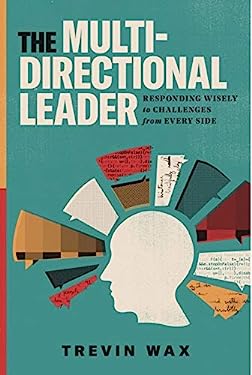
Trevin Wax gives us four ways that we can develop into multi-directional leaders.
1-DELIGHT IN SCRIPTURE, EVEN WHEN IT CHALLENGES OUR SYSTEMS AND ASSUMPTIONS
I had a professor at Moody Bible Institute that used to say that whenever we open up the Bible and read it we need to be open to learning something new. Is that true for us? Or are we simply going to the Word to affirm what we already believe?
2- LISTEN CAREFULLY TO PEOPLE (INCLUDING YOUR CRITICS) WHO SOUND VARIOUS ALARMS
Are we willing to listen to people who are outside of our favorite tribe? Usually the answer to this question is no. Far too many leaders fail to listen to anyone outside of their own little comfortable echo chamber. We don’t have to agree with everything a person says or believes in order to learn from them.
3- KNOW YOURSELF AND THE DANGERS TO WHICH YOU’RE SUSCEPTIBLE
What areas are you quick to talk about or go on the attack? For example, let’s not be the leader who always criticizes liberal theology but fails to ever talk about the dangers of making politics into an idol. What areas of danger do you overlook? As shepherds we need to be willing to look in every direction for the good of our sheep.
4-KNOW YOUR PEOPLE AND THE DANGERS THEY ARE SUSCEPTIBLE
Are we aware of all the different areas of danger for the people in our area of ministry? Or do we only see one side, one angle? This book by Wax has me now asking important questions such as, what am I missing? What am I not seeing? Are there areas of danger for my people that I have been blinded to?
I AM STRONGLY RECOMMENDING THIS BOOK TO YOU
As you might have guessed, I am recommending you buy and read “The Multi-Directional Leader” by Trevin Wax. It is a quick read but I believe it will have a significant impact on you and the people that you lead.
Being a one-directional leader is the path of least resistance and you see it everywhere. On social media most people are only talking about one or two issues and fail to see all the blind spots they have. I think many people with a social media platform know that if they were honest and started challenging their own tribe that they would lose their audience. Without question I have blind spots too but this book is helping me to make appropriate changes so that I can keep growing as a leader. I’ll leave you with one of my favorite quotes from this book:
“Ear-tickling preaching can also consist of strong warnings about real doctrinal dangers-as long as your listeners enjoy hearing about problems that threaten everyone else. Your sermon may be a fiery broadside against a legitimate threat, but if you only alert your flock to dangers they’ve long learned to see clearly, you may consider yourself a prophet, when in reality you’re just a one-directional dispenser of selective warnings.” p. 9-10
Featured image taken from linkedindotcom

 MichaelWallenmeyer.com